
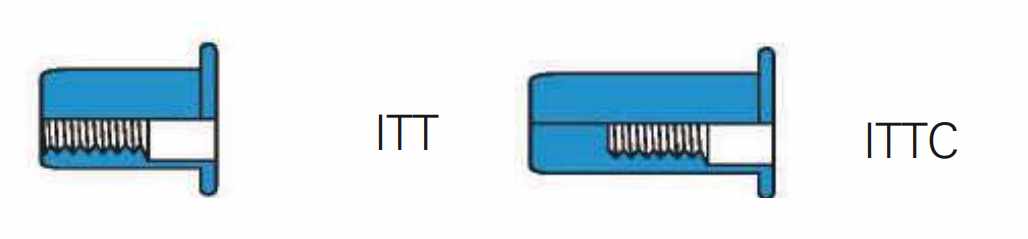
TheITT and ITTC rivet nutsare fasteners designed to provide a metric thread in sheet metal and profiles using a single-sided installation method. Their cylindrical design and flat head allow for the creation of a threaded fixing point without requiring access to the rear side of the material.The range is available in various metric sizes and configurations, allowing for the selection of the appropriate part based on sheet thickness and assembly requirements.
ITT and ITTC rivet nuts
The ITT and ITTC models share a cylindrical body and flat head. The main difference is that the ITTC model has a closed-end (blind) body.
- ITT: cylindrical flat-head rivet nut.
- ITTC: cylindrical flat-head closed-end rivet nut.
This configuration provides a metric thread in different types of sheet metal and profiles, with installation performed from one side of the component.
ITT / ITTC nut features
- Cylindrical geometry.
- Flat head.
- ITTC version with closed-end body.
- Metric thread.
- Single-sided installation.
- Available for various sheet thicknesses.
- Manufactured in steel and stainless steel, depending on the part number.
Materials and finishes
The catalog’s range of rivet nuts is available in various materials. This family primarily includes:
- Zinc-plated steel (Cr(III)).
- A2 stainless steel.
The catalog data sheet identifies the steel asC1008and the stainless steel asAISI 304.
Available sizes
ITT – Cylindrical flat head
| Thread | Part number | Thickness T (mm) |
|---|---|---|
| M3 | BFACITTM03C / BFACITTM03L | 0.5–1.5 |
| M4 | BFACITTM04C / BFACITTM04L | 1.5–2.5 |
| M5 | BFACITTM05C / BFACITTM05L | 0.5–2.0 / 2.0–3.5 |
| M6 | BFACITTM06C / BFACITTM06L | 0.5–3.0 / 3.0–5.5 |
| M8 | BFACITTM08C / BFACITTM08L | 0.5–3.5 / 3.5–6.0 |
| M10 | BFACITTM10C12 / BFACITTM10C13 | 1.0–3.5 / 1.0–2.5 |
| M12 | BFACITT12C15 / BFACITT12C16 | 0.5–3.5 / 1.0–4.0 |
ITTC – Blind flat-head cylindrical
| Thread | Reference | Thickness T (mm) |
|---|---|---|
| M3 | BFACITTCM03C | 0.5–1.5 |
| M4 | BFACITTCM04C / BFACITTCM04L | 0.5–2.0 / 2.0–4.0 |
| M5 | BFACITTCM05C / BFACITTCM05L | 0.5–2.5 / 2.5–5.0 |
| M6 | BFACITTCM06C / BFACITTCM06L | 0.5–3.0 / 3.0–5.5 |
| M8 | BFACITTCM08C / BFACITTCM08L | Depending on configuration |
| M10 | BFACITTCM10C | 1.0–4.0 |
Applications
ITT and ITTC rivet nuts provide a solution for applications requiring athreaded connection on sheet metal or profiles.…and access to the rear side of the workpiece is limited or impossible.
Their use allows for the inclusion of threaded fixing points in various metal structures and assemblies, subsequently facilitating the mounting and dismounting of components using standard fasteners.
Advantages of rivet nuts
One of the main advantages of this system is that it enables the creation of a thread in materials where conventional tapping is not feasible. Installation from a single side also facilitates their use in closed profiles, sheet metal, and structures where the rear side is inaccessible.
The availability of various thread sizes, thicknesses, and materials allows the rivet nut to be adapted to the specific requirements of each application.
Mechanical data
The catalog includes various mechanical tests for the rivet nuts. These include theaxial load test, ultimate tensile load, tightening torque, and shear strength.
For steel and stainless steel nuts, the axial load test values listed in the catalog reach up to34,000 N for M12, while the shear strength reaches up to6,500 N for M12. Values depend on the thread size, material, and nut configuration.
Do you need an ITT or ITTC rivet nut?
To correctly select a rivet nut, it is important to know thethread size, thesheet thicknessand thematerialrequired.
At Bearfix, we offer various rivet nut solutions for industrial applications. If you are unsure which part number you need, contact our team, and we will help you identify the right configuration.
Check out the range ofrivet nutsfrom Bearfix and find the right part number for your application.