Standard Rivets DIN 7337
DIN 7337 standard rivets are mechanical fastening elements used to create permanent joints between two or more components. They are installed from only one side of the joint and provide a fast and repeatable fastening solution by deforming the rivet mandrel during installation.

Within this range, the catalogue includes different head configurations, materials, diameters and lengths, allowing the rivet to be adapted to the characteristics of each application.
Standard rivet range
DIN 7337 standard rivets are available with different head geometries to meet different assembly requirements. The choice of head type mainly depends on the available surface, the space around the fastening point and the required finish.
The main available configurations are:
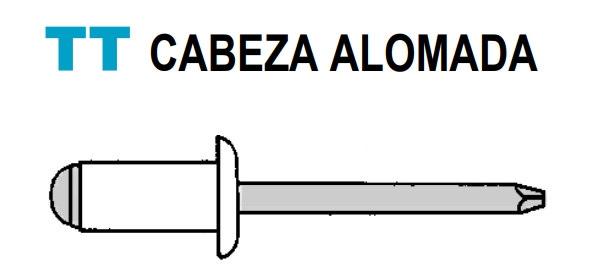
- Dome head rivets (TT): the standard configuration for general-purpose applications.
- Countersunk head rivets (TS): provide a more flush surface when the corresponding countersunk recess is used.
- Large flange rivets (TL): provide a larger bearing surface on the component.
- Extra-large flange rivets (TXL): provide an even larger bearing surface for specific applications.
The catalogue identifies these four configurations within the DIN 7337 standard rivet family.
Dome head rivets
TT dome head rivets are the most widely used configuration within the standard rivet range. Their geometry provides a suitable bearing surface on the component and makes them suitable for a wide variety of fastening applications.
The catalogue includes different combinations of diameter, length and material. This family includes aluminium rivets with zinc-plated steel mandrels, such as the AL-TT series, as well as other material configurations.
Countersunk head rivets
TS countersunk head rivets are designed for applications where the height of the rivet head above the surface of the component needs to be reduced. The sheet or component must have the corresponding countersunk recess.
The AL-TS range uses an aluminium Mg 3.5 head and a zinc-plated steel mandrel and is available in different diameters and lengths.
Large flange rivets
TL large flange rivets feature a larger head diameter than conventional standard rivets, providing a wider bearing surface on the material.
This configuration can be particularly useful when the pressure exerted by the rivet head needs to be distributed over a larger area. The catalogue includes different diameters and lengths with this head geometry.
Extra-large flange rivets
TXL extra-large flange rivets provide an even larger bearing surface and are designed for applications where this characteristic is required.
The range includes references such as AL4008TXL, AL4010TXL, AL4012TXL, AL4014TXL, AL4016TXL and AL4020TXL for 4.0 mm diameters, depending on the lengths available in the catalogue.
Standard rivet materials
The standard rivet range includes different material combinations for the rivet body and mandrel.
Available configurations include aluminium Mg 3.5 with a zinc-plated steel mandrel, used in the AL-TT and AL-TS families. The catalogue also includes other families manufactured in aluminium, zinc-plated steel, stainless steel, copper and other alloys.
The material should be selected according to both the characteristics of the components to be joined and the service conditions of the application.
Diameters and lengths
DIN 7337 standard rivets are available in different diameters and lengths. Depending on the reference and configuration, the catalogue includes diameters ranging from 2.4 mm to 6.4 mm.
For example, the AL-TT family includes diameters of 2.4, 3.0, 3.2, 3.4, 4.0, 4.8, 6.0 and 6.4 mm. Available lengths depend on the diameter and the individual reference.
For this reason, selecting a rivet requires more than knowing its diameter: the appropriate length must also be determined according to the total thickness of the materials to be joined.
DIN 7337 standard
The rivets in this family are identified in the catalogue as DIN 7337 standard rivets. The standard is associated with the different conventional head configurations and their corresponding dimensional tables.
The technical documentation provides the dimensions, available length range, diameter and product code for each reference, making it easier to select the appropriate rivet for each assembly.
Applications of standard rivets
Standard rivets are used to create permanent joints between different components and materials. Their installation system makes it possible to assemble the joint from only one side, which is particularly useful when simultaneous access to both sides is not possible.
The availability of different head types, materials, diameters and lengths allows the rivet to be adapted to applications with different requirements in terms of bearing surface, finish and strength.
Which standard rivet do you need?
The choice of the appropriate rivet mainly depends on four factors: head type, diameter, length and material.
The head should be selected according to the geometry and finish required for the joint; the diameter must be compatible with the hole and expected loads; and the length must correspond to the total thickness of the materials to be joined.
At Bearfix we offer different DIN 7337 standard rivet solutions for industrial applications. If you are unsure which reference you need, contact our team and we will help you identify the most suitable configuration.
Check the Bearfix
standard rivet range
and find the right reference for your application.
Bearfix RIVET range
Select the type of rivet you need below to view its characteristics, dimensions, materials and available references.